


A telemedicine ROP programme built for low-resource settings
Health System Strengthening
Before blindness has a chance to take hold, we screen, detect, and connect infants to the treatment they need.
The Problem
A preventable cause of blindness still blinding children.
Retinopathy of Prematurity (ROP) is a preventable eye condition that can cause blindness in babies born too early if it is not detected and treated in time. The traditional way to detect and treat these newborns is time-consuming and needs highly trained specialists, which are often not available in low-resource settings.
The result is an invisible epidemic: babies who survive their first weeks of life only to lose their sight from a condition that, elsewhere in the world, would have been caught and treated.
Solution
A telemedicine model built for low-resource settings.
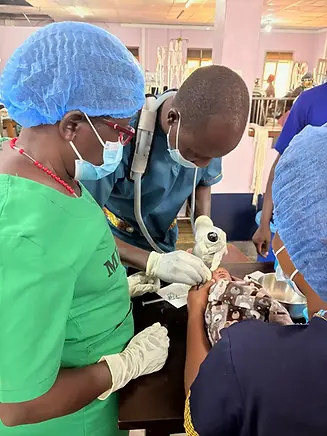
We work with local doctors and nurses to bring proven telemedicine tools and practical training directly to communities where they are most needed. This helps ensure more newborns are screened early and receive timely treatment, preventing avoidable vision loss. By using affordable screening cameras and simple digital tools, we support healthcare workers to identify eye problems quickly and accurately. Our approach strengthens local health facilities so high-quality newborn eye care can grow and continue over time.
01.
Image capture
A trained technician captures retinal images in the NICU using a wide-field camera.
02.
Remote grading
Images are reviewed remotely by a specialist ophthalmologist.
04.
Locally led
03.
Referral and follow-up
Babies needing treatment are referred quickly, while others continue scheduled monitoring.
Every site is run by local clinical staff and technicians. EyeSHA trains, supports, and monitors but the programme belongs to the country.
The programme has been successfully implemented in Kenya and Uganda, building on earlier pilot work in Nigeria. A regional workshop in Ethiopia brought together teams from seven African countries to share lessons and strengthen collaboration around adoption of the solution. Based on this momentum, the programme is now expanding to Tanzania, Zambia, and Zimbabwe. This phased approach supports locally led scale-up across health systems in the region.
Making a difference.
Building stronger systems for neonatal eye care
-
Babies screened to date: [TBC]
-
ROP cases detected: [TBC]
-
Babies Treated: [TBC]


Are you a hospital, government, or funder?
-
If you are based in a country where ROP screening does not yet exist — or where it exists but needs to be scaled we want to hear from you.
-
We work with hospitals, Ministries of Health, and funding partners who share our commitment to sustainable, locally-led Programmes.
-
Whether you want to bring ROP screening to your country or support our expansion work financially, get in touch.